Pool Decks and Patios
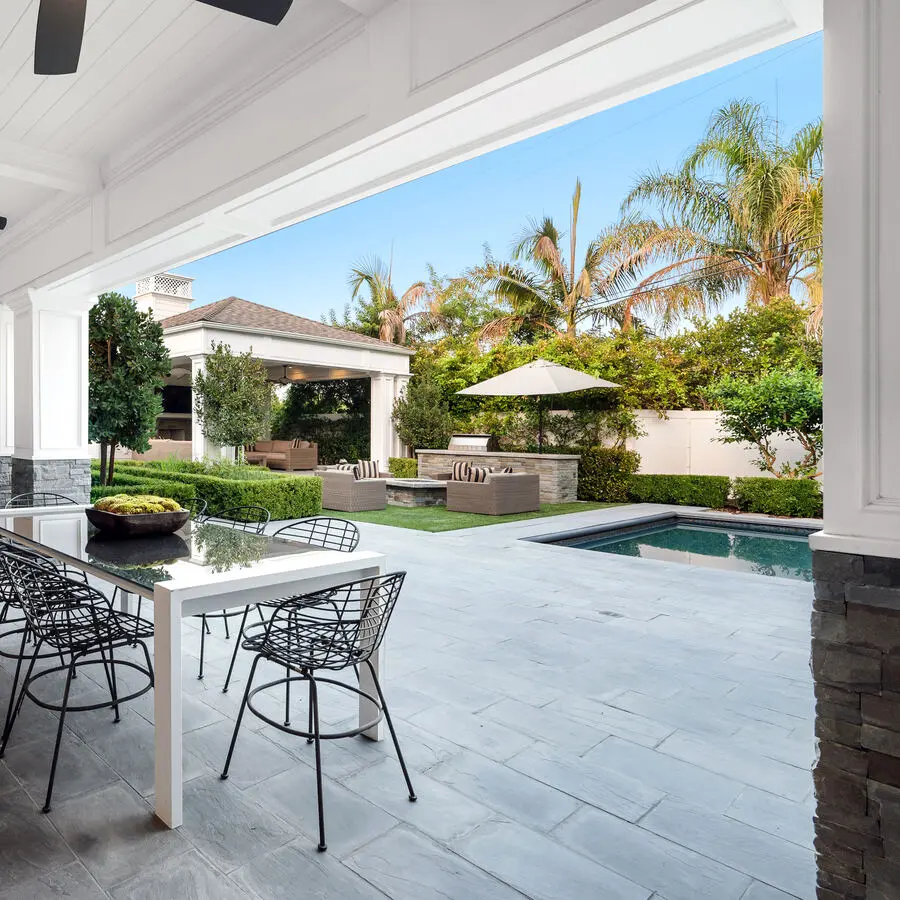
Pool Deck Pavers vs Concrete in Los Angeles: What Homeowners Should Consider
Choosing between pavers and concrete is not only a material decision. A pool deck has to relate to the house, pool, yard, and the way people move through the property. The right direction for one Los Angeles home may feel out of place or create awkward transitions at another.
Before selecting colors or finishes, consider the architecture of the house, pool shape, existing coping, doors and thresholds, outdoor seating, and routes to side yards or gates. A thoughtful pool deck and patio plan should also account for drainage, planting, shade, maintenance access, and visual continuity across the yard.
How the House, Yard, and Circulation Affect the Choice
A clean-lined home may call for large, simple paving modules or a restrained concrete finish. A more traditional property might work well with smaller-format pavers, detailed borders, or concrete divided into carefully proportioned panels. These are design tendencies, not rules; actual samples should be viewed next to the house and pool.
Circulation matters just as much as appearance. Look at the path from the house to the pool, the route to the equipment area, and how guests reach seating or lawn areas. Narrow passages, abrupt level changes, and poorly placed furniture zones can make a spacious deck inconvenient to use.
What to Know About Pool Deck Pavers
Pavers create a modular surface made from individual units. Their size, shape, color, pattern, and border treatment can be adjusted to complement the pool and surrounding landscape. The modular layout can also help define dining areas, lounge zones, walkways, and transitions to gravel or planting beds.
Individual units can often be lifted and replaced if access is needed below the surface or a paver becomes damaged. A replacement may not look identical because of weathering, product changes, or differences between manufacturing lots, so keeping a few extra units from the original installation may be useful.
Pavers depend heavily on what is underneath and around them. Base preparation, compaction, bedding material, joint treatment, and edge restraint all contribute to long-term performance. Poor preparation can contribute to settlement, uneven joints, movement, or low areas that collect water.
What to Know About Concrete Pool Decks
Concrete forms a continuous surface rather than a field of individual units. It can create a simple visual foundation around a pool and may work well when homeowners want broad, uninterrupted areas. Appearance can be influenced through color, texture, scoring, joint layout, and other finish choices.
Preparation remains important. Existing soil conditions, demolition limits, subgrade work, drainage, placement access, and the project-specific installation plan can all affect the result. Control joints and other planned separations should be considered as part of the design rather than treated as an afterthought.
Concrete can develop cracks as materials and site conditions change over time. Planning and preparation can help manage risk, but a crack-proof installation should not be promised. Repairs are possible, although matching an older slab's color, texture, and weathering can be difficult.
Surface Temperature, Slip Resistance, and Bare-Foot Comfort
No material category is always cooler around a pool. Surface temperature depends on color, finish, density, sun exposure, shade, time of day, and the specific product or concrete treatment. A pale surface may perform differently from a dark version of the same material.
Slip resistance and bare-foot comfort also vary by product and finish. A texture that offers useful traction may feel rougher underfoot, while a very smooth finish may behave differently when wet. Review actual paver or concrete finish samples whenever possible, both dry and wet. Samples support an informed decision, but they do not create a safety guarantee.
Site Planning Before Installation
Drainage and existing elevations
The deck needs a deliberate drainage strategy. Existing door thresholds, pool coping, drains, lawn elevations, walls, and neighboring surfaces may limit where the finished deck can sit. Slope should direct water toward intended drainage locations without creating uncomfortable transitions or low spots.
Coping and transitions
Determine whether existing pool coping will remain, be modified, or be replaced. Its height, thickness, shape, and joint with the deck affect both pavers and concrete. Transitions to turf, sod, gravel, steps, walkways, and seating areas also need defined edges and compatible elevations.
Access, demolition, and sequence
Los Angeles properties can have tight side-yard access, mature landscaping, slopes, or limited space for equipment and materials. Access affects demolition, hauling, base work, concrete placement, and protection of areas that will remain. The installation sequence should be adapted to the property.
Pavers and Concrete at a Glance
- Surface format: pavers use individual modules; concrete creates a continuous placed surface.
- Design: pavers offer patterns, borders, and unit combinations; concrete offers finish, color, scoring, and joint-layout options.
- Repairs: individual pavers may be replaceable; concrete repairs may remain visible because matching aged material is difficult.
- Movement: paver joints divide the surface into units, but settlement can occur; concrete uses planned joints, yet cracking remains possible.
- Installation: pavers depend on base preparation, joints, and edge restraint; concrete depends on preparation, placement planning, finishing, and joint design.
- Comfort: temperature, traction, and bare-foot feel depend on the specific color, product, finish, and exposure rather than the category alone.
Maintenance Expectations
Paver maintenance can include cleaning, joint-sand attention, weed management, and correcting isolated settlement. Weeds usually take hold in accumulated organic material near the surface rather than growing through an intact paver, but joints still require observation.
Concrete maintenance may include routine cleaning and attention to joints, cracks, stains, sealers, or finish wear when applicable. Aggressive cleaning methods can affect certain finishes, so maintenance should reflect the actual surface treatment.
Connecting the Deck to the Rest of the Landscape
A pool deck rarely works in isolation. Coordinated walkways can lead from the house or side gate without introducing awkward material changes. Planting beds can soften broad hardscape areas, add shade or screening, and help frame views from inside the home. Plant selection should also consider litter, roots, irrigation, and proximity to the pool; learn more about our planting services.
Turf or sod can provide visual relief from hard surfaces, while gravel can define low-use zones, drainage areas, or transitions around planting. Different pebble, rock, and gravel options vary in size, color, and how they feel underfoot. Seating areas should be sized around actual furniture and circulation space rather than treated as leftover corners.
What Affects Project Cost?
There is no reliable price comparison without reviewing the site and intended design. Important cost factors include:
- Deck area, layout, curves, borders, patterns, and number of cuts
- Material selection and finish complexity
- Demolition, disposal, and existing surface conditions
- Access for workers, equipment, delivery, and material staging
- Base or subgrade correction and project-specific preparation
- Drainage changes, coping work, steps, walls, and elevation adjustments
- Protection or restoration of planting, turf, irrigation, and adjacent surfaces
A simpler material is not necessarily a simpler project. Site access, drainage corrections, demolition, and detailed transitions can influence labor and planning as much as the visible surface.
Making the Decision
Pavers may appeal to homeowners who value modular design, defined patterns, and the ability to replace individual units. Concrete may suit homeowners seeking a visually continuous surface with carefully planned finishes and joints. The choice should follow a site review rather than a broad claim that one material is always preferable.
Viewing completed work can help clarify scale, color, borders, and landscape relationships. Visit the ABC LandCrafters project gallery for examples of real outdoor projects.
Discuss Your Pool Deck or Patio Project
ABC LandCrafters can help you compare pavers and concrete in the context of your pool, drainage, coping, access, and surrounding landscape.
Request a ConsultationFrequently Asked Questions
Are pavers always more expensive than concrete?
No. Cost depends on the selected paver or concrete finish, demolition, access, base preparation, drainage, coping, layout complexity, and other site conditions. A site review is needed for a useful comparison.
Which pool deck material stays cooler in Los Angeles sun?
Neither category is always cooler. Color, finish, material composition, shade, orientation, and sun exposure all affect surface temperature. Compare actual samples and consider where afternoon sun reaches the deck.
Can pavers be installed over an existing concrete deck?
Sometimes an existing slab can be part of a proposed system, but it must be evaluated first. Its condition, drainage, cracks, coping relationship, thresholds, and available elevation determine whether removal or another approach is more appropriate.
Do pavers eliminate cracking problems?
Pavers do not form one continuous slab, so their joints accommodate movement differently. They can still settle, shift, chip, or become uneven if the base, drainage, joints, or edges do not perform as intended.
Do I need to redesign the entire yard with the pool deck?
Not necessarily. However, reviewing walkways, planting, turf or sod, gravel, seating, drainage, and access together can prevent disconnected transitions. Improvements can often be planned in phases.
Call 818-699-1516, email ron@abclandcrafters.com, or contact ABC LandCrafters to discuss your project.